Third Text
Nalini Malani: ‘Of Woman Born’
Shalmali Shetty reviews Nalini Malani’s ‘Of Woman Born’, the Indian artist’s "monumental solo exhibition", one of this year’s 61st Venice Biennale’s collateral events (9 May – 22 November 2026), and speaks with both the artist and the curator, Roobina Karode.
30 October 2026
Nalini Malani, ‘Of Woman Born’, Magazzini del Sale n. 5, Venice, Italy, 9 May – 22 November 2026 – a Collateral Event at the 61st Venice Biennale, presented by Kiran Nadar Museum of Art (KNMA), New Delhi
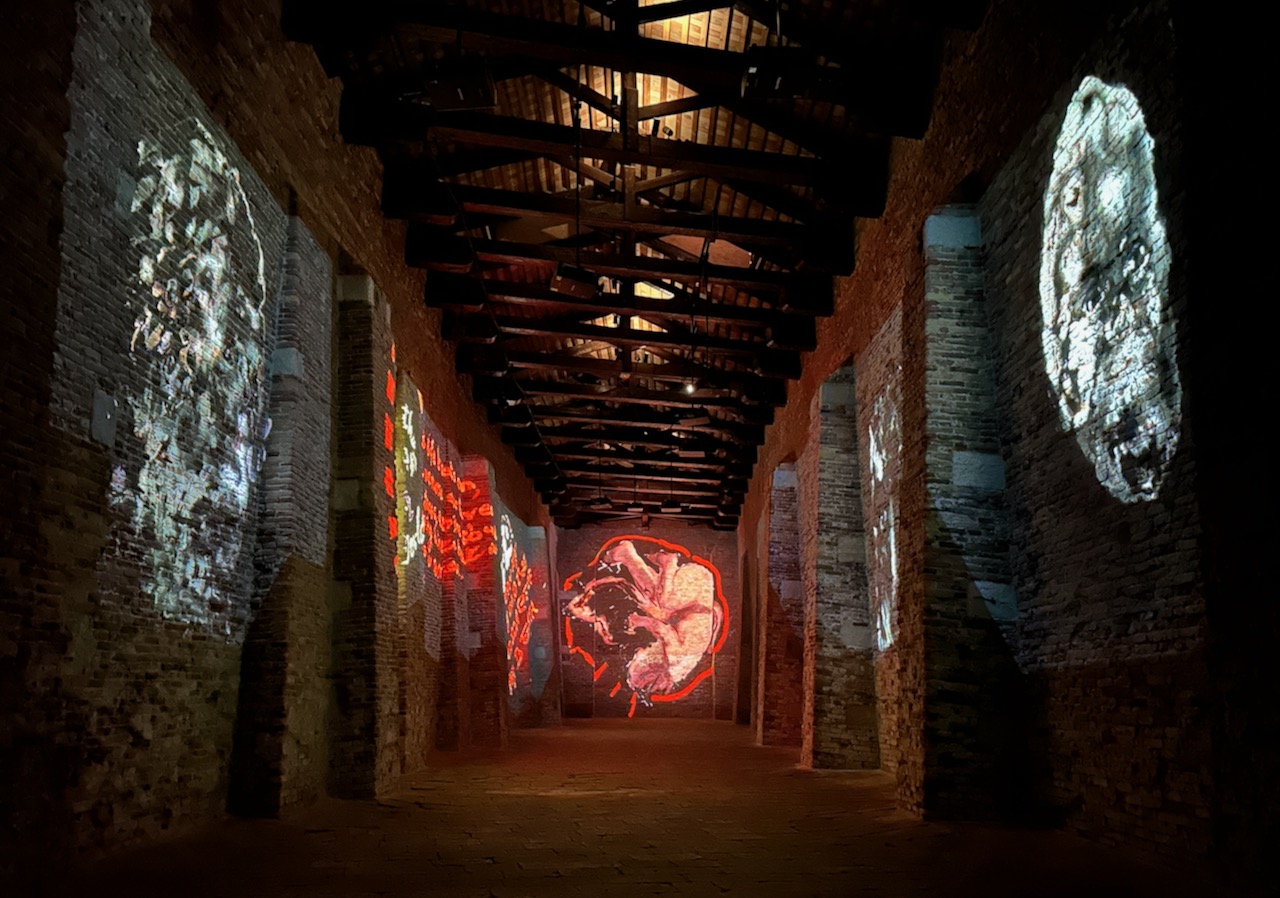
Nalini Malani, ‘Of Woman Born’, installation view, Magazzini del Sale n. 5, Venice, 2026, 9 channel iPad Animation Chamber, sound, dimensions variable, collection Kiran Nadar Museum of Art, courtesy of the artist
Entering the cavernous expanse of Sala 5 at the Magazzini del Sale in Venice feels like crossing a threshold into a visceral confrontation with what we have permitted ourselves to forget. This became the sensorial staging ground for ‘Of Woman Born’, Nalini Malani’s monumental solo exhibition, curated by Roobina Karode and presented by the Kiran Nadar Museum of Art (KNMA), New Delhi, as an official collateral event of the 61st Venice Biennale. Within the dark interiors of this fifteenth-century Venetian salt warehouse, Malani orchestrates a relentless cacophony of visuals projected onto the bare, salt-encrusted brick walls, their porous architecture still white with centuries of mineral efflorescence. Flickering flashes of white light and shadow are dominated by intense red hues, overlaid with a haunting, disembodied polyphonic soundtrack. The atmosphere compels us to sit in a discomfort that demands collective listening and witnessing, mirroring the incongruity of pain and trauma in the wake of the brutal, ongoing erasure of the generative mother.
The exhibition takes its title from Adrienne Rich’s 1976 text Of Woman Born: Motherhood as Experience and Institution, and her imperative to ‘think through the body’. [1] Given her feminist practice, Malani adopts this framework to interrogate how patriarchal systems sanitise motherhood while obscuring women’s lived realities. Superimposing ancient myths, colonial histories and postcolonial realities, and by centring the female body as a site of embodied knowledge and memory she challenges structures built on historical extraction and state violence.
‘Of Woman Born’ draws from Aeschylus’s tragedy Oresteia – the ancient Greek trilogy depicting the downfall of the cursed House of Atreus and the mythic origins of Western jurisprudence – the exhibition’s visual and textual narrative hinges on Orestes’s murder of his mother, Clytemnestra, to avenge her killing of his father, Agamemnon. Yet Clytemnestra’s own vengeance was borne of a mother’s rage after Agamemnon sacrificed their daughter, Iphigenia, for political and military gain, a marriage further broken by mutual infidelity. Pursued and driven to the brink of madness by the Erinyes or Furies – the ancient, chthonic deities of maternal vengeance – Orestes is eventually exonerated through a trial presided over by Athena. This divine verdict justifies Orestes’s matricide and strips the Furies of their mandate, diluting them of their female rage.
With Apollo’s claim that the mother is not a parent, but merely an interchangeable vessel for the father’s lineage, Athena’s court establishes the institutional victory of patriarchal law over matriarchal rights, codifying a foundation for Western legal systems that would subsequently be exported through centuries of colonial rule. In this exhibition, the dehumanisation of the mother moves beyond an artefact of antiquity, becoming a spectral presence that actively conditions modern statehood – a world built on patriarchal conquest, where those who nurture life are systematically silenced, oppressed, raped, murdered or erased.
Born in Karachi in 1946, Nalini Malani was displaced as an infant during the 1947 Partition of India and Pakistan – a moment of immediate, widespread trauma that overshadowed the official celebrations of independence from the British. Growing up in post-independence India across Kolkata and Mumbai, her life and practice have been shaped by the postcolonial nation-state that continues to inform her critique of border violence and recurring communal conflict. ‘Of Woman Born’ marks Malani’s fourth major presentation in Venice over the past two decades, continuing a longstanding relationship with the city through the official Collateral Events of the Biennale. From ‘Mother India’ (2005), ‘Splitting the Other’ (2007) and ‘In Search of Vanished Blood’ (2019), Malani has returned to the city as an important site of political and historical reckoning.
In ‘Of Woman Born’, her critique finds material resonance in the exhibition site itself: the fifteenth-century Magazzini del Sale. In Renaissance Venice, the salt trade formed the bedrock of maritime dominance, controlled by the Ordo Salis (Salt Office) to fund imperial expansion. Centuries later, the British Empire deployed a similar logic in colonial India by imposing an oppressive Salt Tax and constructing the 4,000-kilometre Great Hedge to enforce a state monopoly on a basic human necessity. By projecting onto the walls of this historic warehouse, Malani links Venice’s mercantile past and the anticolonial struggles of the Global South, turning salt into an indelible symbol of imperial greed and human suffering.
For this exhibition, Malani moves from her signature reverse-painting techniques and revolving Mylar cylinders to experiment with the immediacy of digital iPad animation. By drawing directly onto the screen with her fingers, she produced over 30,000 digital drawings compiled into sixty-seven distinct animations, using hand-drawn text and imagery as rapid visual annotations to respond to contemporary global atrocities with unprecedented speed. The installation presents nine projections that transform the linear warehouse into an animation chamber, what Malani calls a ‘cathedral’. Eight large-scale projections flank the long hall along walls separated by internal buttresses – four on the left, four on the right – which come into visibility sequentially as one walks down the central nave towards a ninth projection at the far end. Lasting between two and five minutes, the animation loops run simultaneously, tracing the creative labour of making the work, the cycle of historical violence and the workings of memory itself. Akin to the relentless stream of media spectacles that either paralyses us in the face of unprecedented horror or dulls us into apathy through sheer saturation, this exhibition captures a pervasive sense of doom. Set against a backdrop of ongoing genocide, femicide and ecocide exacerbated by capitalist expansion and the global escalation of authoritarianism, it directly implicates the viewer as a complicit witness.

Nalini Malani, ‘Of Woman Born’, installation view, Magazzini del Sale n. 5, Venice, 2026, 9 channel iPad Animation Chamber, sound, dimensions variable, collection Kiran Nadar Museum of Art, courtesy of the artist
The animations unfold as luminous, sketchy and smudgy unfinished compositions that recall graphic collages of cutouts and silhouettes, street graffiti, shadow puppetry and hand-flipped kineographs. Uncanny and disorienting, these visual sequences are further fragmented by the warehouse’s rugged architecture. What initially appear as raw, childlike abstractions, quickly mutate into terrifying visceral images of tangled intestines, disembodied limbs, floating hands, severed heads, scattered skeletons, and the cyclical passage between birth and death unfolding in pools of blood and fluid. In her catalogue essay for the exhibition, Malani cites an adage attributed to Hannah Arendt: ‘The death of human empathy is one of the earliest and most telling signs of a culture about to fall into barbarism.’
Malani’s work operates, therefore, on the premise that war begins when we refuse to be perceptive to another’s lived experience; when a singular, tyrannical authority violently erases all other viewpoints and catastrophically oppresses the marginalised. A girl skips rope while children play on a seesaw and a giant stride, but the scene turns sinister as military planes and tanks follow, recalling the unsparing violence inflicted on the young, including the recent ban on Palestinian children flying kites from open rooftops. [2] Floating text fragments punctuate these trembling sketches with declarations: ‘Adults are not grown up’, ‘Adults cannot take care of us’ and ‘The lust for power never dies’. Exhausted, the skipping girl sighs, ‘I’m tired, I’m tired, I’m tired’, before collapsing, standing back up and resuming her play. Malani juxtaposes these innocent gestures of play against the terrifying shadow of a looming future, a world where adult violence constantly betrays the young: ‘Who has the right to take away the vision of the child?’

Nalini Malani, ‘Of Woman Born’, installation view, Magazzini del Sale n. 5, Venice, 2026, 9 channel iPad Animation Chamber, sound, dimensions variable, collection Kiran Nadar Museum of Art, courtesy of the artist
Eyes scream as mouths are gagged; ears are deafened by violence; dead babies lie wrapped in shrouds; women crouch for mercy before rifle-wielding men; a woman confronts an armed soldier with the fierce refusal ‘you can’t take my home away’. From one open mouth, the phrase ‘the horror, the horror, the horror’ is visually shouted into space, while fragmented maps of the Middle East, engulfed in red and haunted by spectres of the dead, reflect the wider mechanics of colonial conquest, settlement and resistance. These graphic horrors recall Francisco Goya’s satirical print series Los Caprichos and The Disasters of War, as well as the cannibalistic nightmare of his painting Saturn Devouring His Son, realising his famous warning that the sleep of reason produces monsters.
Looking around, one is confronted by dizzying spectres of Cassandra, Clytemnestra and Medea converging with the ghosts of wounded mothers and infants, as traumatic memories resurface belatedly through forms of hysteria and grief. The vulnerable female body becomes a ‘reservoir of pain’ under the gaze of Athena – ‘Child sprung full-blown from the Olympian Zeus, never bred in the darkness of the womb…’ – standing witness to the destruction and assault of the maternal figure: motherhood, mother earth, mother nature and the nation-state. As one animation screams in red, green, black and white: ‘Who will ask the women?’, it demands a fundamental conjecture: what if our socio-political structures were guided by a female-led ethos of care, community and kinship? We are reminded that unless we listen to those from whom we are all born, we will remain trapped in an endless cycle of self-destruction and collective amnesia.
Running just over twenty minutes, the projections are set to an eerie soundtrack composed by Neha Karode, featuring spoken-word recitations by Malani and Karode. The audio brings together passages from Aeschylus’s Oresteia, Joseph Conrad’s Heart of Darkness and T S Eliot’s The Hollow Men, alongside Malani’s written interjections. It begins with a probing interrogation of a woman’s identity, cycling through piano chords and ambient instrumentation. Ancient legal misogyny is laid bare with the recitation of Apollo’s defense of matricide, before dissolving into Eliot’s mournful lines: ‘This is the way the world ends / Not with a bang but a whimper.’
The 61st Venice Biennale exhibition, ‘In Minor Keys’, curated posthumously by Artistic Director Koyo Kouoh, calls for an attunement to subtle, under-represented frequencies, quiet resistance, and the acknowledgement of the heavy weight of historical fatigue. In her curatorial address written before her untimely and sudden passing in May 2025, Kouoh wrote: ‘…quite frankly. I am tired. People are tired. We are all tired. The world is tired. Even art itself is tired.’ [3] These words resonate with Malani’s animation of the skipping girl repeating the refrain ‘I am tired’ – a work created in 2024 that eerily anticipates the Artistic Director’s lament. Both articulate a sense of structural exhaustion: the weariness of women, refugees, displaced bodies and marginalised identities who continuously bear the physical and psychological toll of violence and systemic neglect in a civilisation progressing towards its absolute limit.
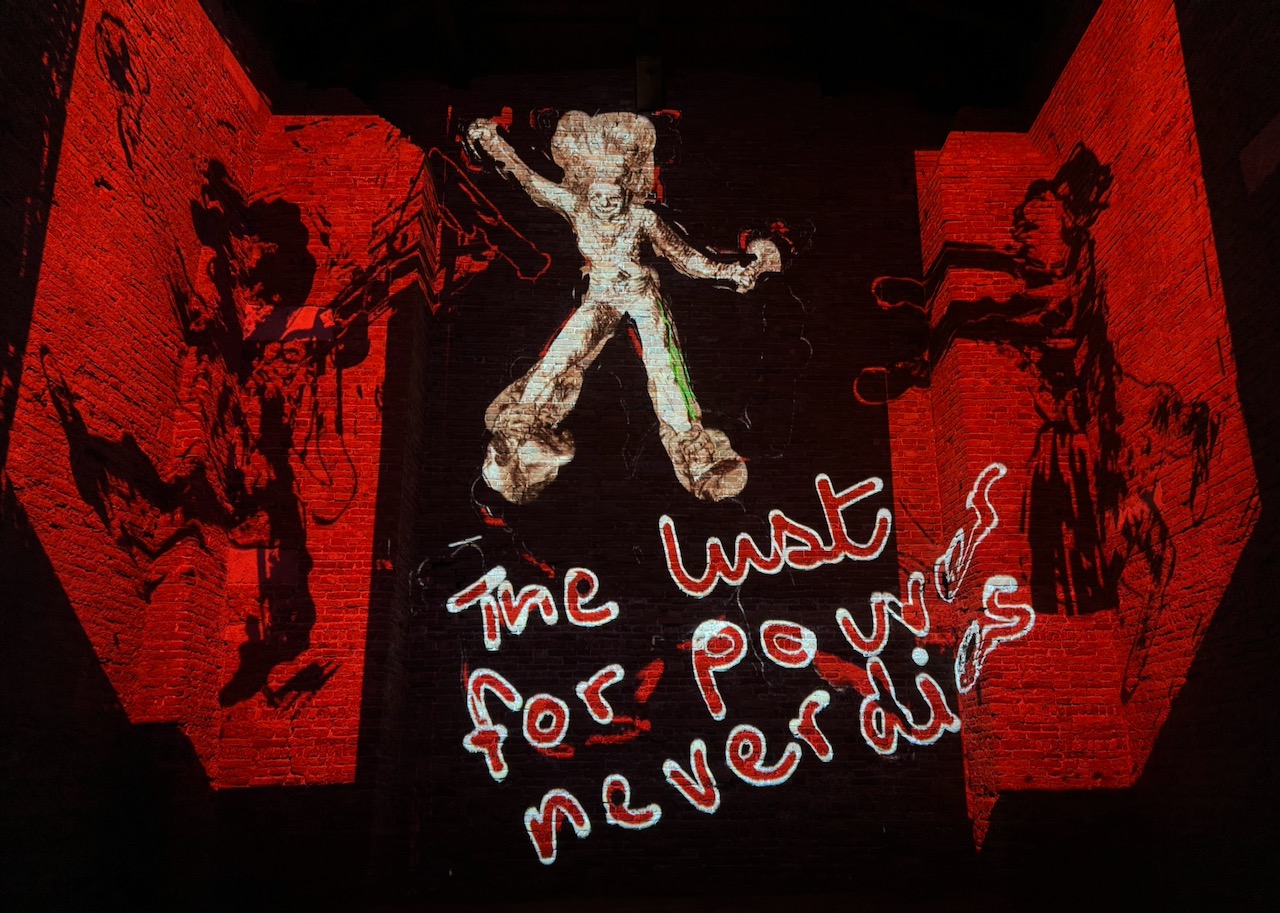
Nalini Malani, ‘Of Woman Born’, installation view, Magazzini del Sale n. 5, Venice, 2026, 9 channel iPad Animation Chamber, sound, dimensions variable, collection Kiran Nadar Museum of Art, courtesy of the artist
In the following conversations with Nalini Malani and curator Roobina Karode, they unpack the making of ‘Of Woman Born’, the choice to site the work within the historic Magazzini del Sale, and the possibility of artistic practice at the edge of historical exhaustion.
Shalmali Shetty (SS): The ‘skipping girl’ figure recurs across your animation work. Why did you choose this image, and what does the act of skipping mean for you in relation to repetition, survival or resistance?
Nalini Malani (NM): The Skipping Girl, the protagonist in ‘Of Woman Born’, has been a recurring image in my work. I started making her as early as the painting series Mutants, in the 1990s. Over more than three decades she has stayed with me throughout, in many media, as painting, zoetrope, stop motion animation and video. I can imbue her with many different emotions: sheer joy, exuberance, excitement, anxiety, hysteria, sadness and trauma. She is also for me a figure of innocence, freedom and hope. When the world collapses into conflict or the harshness of a patriarchal state, children still find a way to survive, even play. In that sense, her repetitive skipping is not just a playful motion; it becomes a profound act of endurance.
SS: When you begin a new animation chamber or series today, what usually appears first for you (a visual image, a phrase, a memory, or a response to an event) and how does it develop into a full installation?
NM: The making of this work was like a cellular growth of ideas and forms, that took on a new life in the process. The catalyst is almost always a profound sense of anger or distress regarding contemporary events – things that make me want to clench my fists, grit my teeth and shout. I feel compelled to find a physical form to contain that rage. Once the architecture of the exhibition space is found or created, it begins to shape the narrative layout. The ideas then grow organically, in this case buttress after buttress, expanding into multiple channels where images layer and bleed into one another until they take over the environment entirely.
SS: Your installations place the viewer inside multiple projections, sounds and texts at once. What kind of attention do you hope to activate in the viewer when they are physically inside the work?
NM: The artwork comes alive in a three-bodied relationship: the artist, the artwork and the viewer. It is not doing anything until we wake it up and talk about it. Otherwise, it is in slumber. Together we have a moment of repartee.
SS: Your work brings together mythology, literature and contemporary political events. How do you bring these different materials together when you are actually making a work; how do you decide what can sit together in the same work?
NM: As an artist, I’m very interested in the porosity of structures/narratives that we otherwise see as definitive. In my work I engage with the past, present and future like a flowing river. When it comes to a rock or a stone, it eddies around and you get another reading. That is the dynamics it makes in living history, where newer things are constantly coming up, providing multiple ways of looking at the world. Myths bring us certain truths that don’t necessarily have an author and the ripple effect through the ages continue to offer ways of reading the present. Whether it is Greek or Indian mythologies, it is the artist’s prerogative to extend these myths to speak about the current times.
SS: You move between hand-drawing, Mylar work and digital tools like the iPad. What changes, and what remains the same, when you move from physical drawing to digital animation?
NM: ‘Of Woman Born’ is created on the iPad on which I draw with my fingers; the process is almost like a child smudging away. For ‘Of Woman Born’, I completed close to 30,000 drawings, which translate into sixty-seven animations in a 9-channel video projection. The technological tools have changed drastically, allowing for an immense scale of production and rapid transitions, but the core human impetus behind the drawing remains entirely unchanged. My practice has always been anchored in a physical, painterly gesture – whether it is reverse painting on Mylar where colours bleed into one another, or drawing directly onto gallery walls where the studio becomes a public performance. Moving to the digital glass of the iPad preserves that fundamental, intimate touch of the hand while granting the freedom to quickly erase, conceal and reinterpret imagery to build a complex, layered multi-channel installation.
SS: After decades of working with themes of violence, witnessing and the figure of the woman, what continues to feel urgent for you in your practice today?
NM: There is an extreme moment now where masculinity has taken over in such a virulent way that the other genders are being annihilated. It is about time we wake up and resist. More than half of the global population continues to be oppressed by deep-seated patriarchal frameworks. My practice continues to address the silenced voices and demand a shift toward empathy, equality and a more humane future.

Nalini Malani, ‘Of Woman Born’, installation view, Magazzini del Sale n. 5, Venice, 2026, 9 channel iPad Animation Chamber, sound, dimensions variable, collection Kiran Nadar Museum of Art, courtesy of the artist
Following Nalini Malani’s reflections on her creative process, Roobina Karode, Director and Chief Curator of the Kiran Nadar Museum of Art (KNMA), offers insight into the decisions that shaped the exhibition experience.
Shalmali Shetty: What felt different or new about curating ‘Of Woman Born’ at this particular moment?
Roobina Karode (RK): Over the months leading up to the project, Nalini and I spoke often about the escalating violence and devastation witnessed in the world and everything she was reading and turning over in her mind. The deeper she went into past histories and different mythologies, she was deeply struck by the treatment of women, the ‘forgotten gender’ turned out to be across traditions – whether she was looking at Greek mythology or Hindu mythology, or even the news coming out of the world around us, the underlying pattern repeated itself: women punished, silenced, erased out of their own stories and by the larger narratives of history.
There was a moment I remember vividly, when she called me almost unable to contain her emotion over a coincidence she had noticed. Decades earlier, in the 1990s, Nalini had drawn a young girl skipping rope, saying ‘I’m tired’, which for her became the image that would anchor this new work. On the surface, the image is suggestive of innocence and play, but for her it also carried the weight of endless repetition – the labour of having to iterate the same thing again and again. That, to me, is what felt different this time: after fifty years of asking these same questions in different forms, there was a rawness to how visibly the toll of that repetition showed in the work itself. Figures she has returned to for decades, like Cassandra, Medea and Sita, resurface here too, but the work moves through something closer to grief: frustration building into anger, and finally settling into something quieter, almost like a lullaby, a child’s voice suggesting the world might simply end in silence rather than spectacle. That emotional arc, from exhaustion to that hushed ending, and the hope of renewal through the tired yet resurrecting skipping girl employed the syntax she evolved and the breadth of her practice quite intensely and differently in ‘Of Woman Born’.
SS: What did the Magazzini del Sale make possible for the work that a conventional gallery couldn’t?
RK: The site itself carries a weight that no white cube space or gallery could replicate. As one of the several former salt warehouses along Venice’s waterfront, it once held stores of the salt trade that helped finance the city’s shipbuilding and its expansion as a maritime power. Salt has its own complex colonial history, and placing the work inside a structure so materially tied to those histories of extraction and empire felt important rather than incidental. The bare brick walls, worn down by salt, gave the installation an enclosed, almost bodily quality, somewhere between a tomb and a womb, that a neutral gallery wall simply could not offer. The projections on the uneven skin of the bruised, weathered heritage walls created a psychological immersion, with thousands of images appearing, disappearing and reappearing, unfolding multiple narratives. ‘Of Woman Born’ does not let you observe from a comfortable distance; it draws the viewer to stay inside the discomfort, to sit with grief rather than resolve it quickly. Initiated by the site, Magazzini del Sale gave us the gravity the work needed to make that demand of its audience.
SS: What were some of the curatorial decisions involved in shaping how audiences encounter the work?
RK: Nalini built the installation across nine channels of projection, using the warehouse's own exposed brick as the surface for images drawn originally on an iPad by hand. The figures that move through the space – mythic characters, drawn silhouettes, fragments of text, vivid soundscapes – these were never meant to cohere into one tidy narrative. A twenty-minute soundscape runs continuously through the chamber, layering different moments in time on top of each other so that past and present, myth and lived history, justice and its absence all bleed into one another. The structure is deliberately non-linear, mirroring how memory actually resurfaces – in fragments, out of order, repeating. What mattered most to us was that the visitors aren’t simply looking at a screen from outside but are physically surrounded by a cacophony of images, implicated by their presence inside the chamber rather than standing safely apart from it. The ‘animation chamber’, as Nalini calls it, transformed into a cave – or, for some, into a cathedral for deep engagement and reflection.
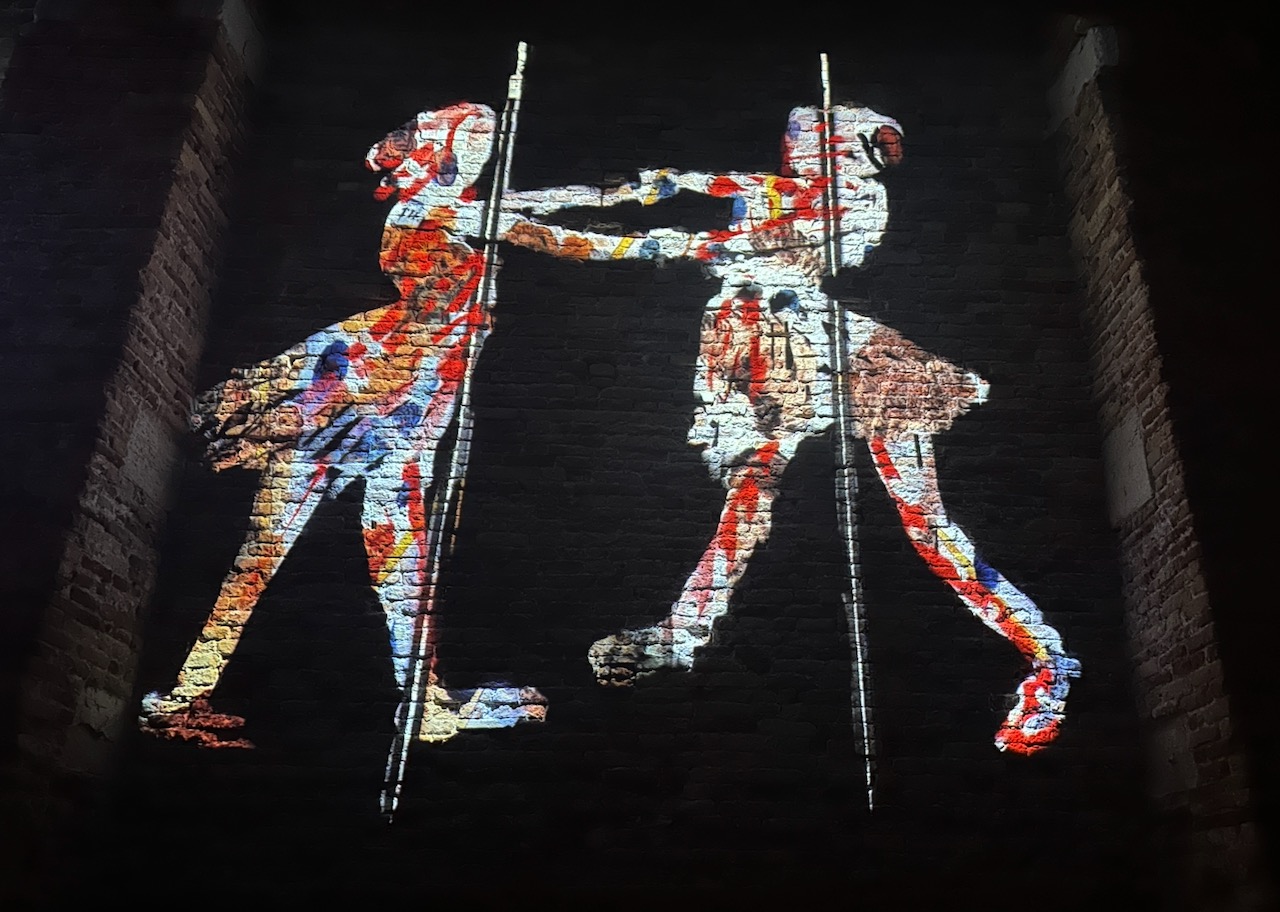
Nalini Malani, ‘Of Woman Born’, installation view, Magazzini del Sale n. 5, Venice, 2026, 9 channel iPad Animation Chamber, sound, dimensions variable, collection Kiran Nadar Museum of Art, courtesy of the artist
SS: Looking ahead to Nalini Malani’s major survey at Tate Modern in London in 2027, how do you see ‘Of Woman Born’ within the larger trajectory of her practice, particularly after your long curatorial engagement with her work at KNMA?
RK: I have known Nalini’s work for decades and have closely witnessed key transitions in her artistic trajectory. One unique shift I have noticed in ‘Of Woman Born’ is in its legibility. Unlike the earlier works such as Can you Hear Me?, the sound in this work is a distinctly spoken word that culminates in a lullaby. The sonic layers in her earlier video works often consisted of shrieks and shrills and rarely transitioned into language. It was interesting to see this shift at this stage in Nalini’s career.
Like many others, I am also eagerly waiting to see what will unfold in her upcoming show at Tate Modern in 2027. [4] As a survey of her work, it will be an incredible opportunity for audiences in the UK to see Nalini’s contribution to conversations about the agency of women and other minorities across cultural contexts, and to understand the importance of her artistic legacy in global contemporary art.
[1] Adrienne Rich, Of Woman Born: Motherhood as Experience and Institution was originally published by the American publisher W W Norton & Company in 1976.
[2] See Oroub El-Abed, ‘When a kite becomes a threat: What Gaza’s children reveal about the politics of fear’, Middle East Monitor, 25 August 2026
[3] See Elaine Y J Zheng, ‘2026 Venice Biennale Forges on With the Vision of Late Curator Koyo Kouoh’, Ocula, 28 May 2025
[4] Nalini Malani’s major solo survey exhibition opening at Tate Modern in London in July 2027 – coinciding with the 80th year since Indian Independence and Partition – will offer the UK and international audiences an encounter with the full sweep of her multi-decadal practice.
Shalmali Shetty is an independent curator and writer based in Glasgow working between the UK and India. Supported by the Charles Wallace India Trust Scholarship, she holds an MLitt in Curatorial Practice from The Glasgow School of Art. Her writing has appeared in Frieze, The Art Journal, The Skinny and Scottish Art News, amongst others. She curated ‘Alia Syed: The Ring in the Fish’ at the Centre for Contemporary Arts, Glasgow in 2025, and currently serves on the Board of Trustees for the Scottish Contemporary Art Network (SCAN). Her research interests include themes of archives, memory and hauntology, extending her focus through the familiar framework of India and its neocolonial relationship to the West. shalmalishetty.wordpress.com