Third Text
Sensory Walking Workshops in Tokyo and Havana
Chloe Pare-Anastasiadou on two public/participatory workshop projects she designed and facilitated in two contrasting cities, and with differing participants – both involving either papermaking or Japanese washi paper in some way.
28 May 2026
Introduction
Art in the public sphere is a topic of discussion in both artistic and academic contexts. [1] Socially-engaged art has been discussed extensively since the 1990s. Some of the most widespread theoretical approaches include new genre public art, often non-institutional activist artmaking that directly engages with the audience; [2] participatory art, often left out of art criticism because of its social significance; [3] and the concept of relational aesthetics, an aestheticised emancipation of the spectator, that makes all art audience-intertwined. [4] While acknowledging the pre-existing discourses, I focus here on an embodied tracing of art-making in the public sphere.
These discursive terms were coined and have been discussed prevalently in the Global North. Both the Greek and Japanese contemporary art contexts are at the geographic edges and sometimes reverberations of the Global North, which makes their localities very multifaceted and fascinating to research. The public space in Greece offers many possibilities for dynamic activities due to the ever-changing conditions. In Japan, there exists a vibrant scene of non-institutional, ephemeral and socially engaged artistic practices, called アートプロジェクト [art projects]. [5] In this article, I aim to highlight the intersections of polycentric perceptions, entangled with my identity as a Greek artist living in Japan.
I am a visual artist and researcher. I grew up and studied in Athens, and for the last five years I have been living and working in Tokyo. My practice takes the form of sculptural installations, workshops and art books, through which I attempt to approach how individual and collective narratives are intertwined. It is through this subjectivity that this article is composed, and where I narrate with the autoethnographic method: connecting personal experiences with broader social meanings and producing knowledge. Although autoethnography is widely used in the humanities today, historically it has been a radical, critical stance to pre-existing methods of inquiry. Intertwining personal narrative and cultural analysis, autoethnography challenges the traditional boundaries of academic discourse, which has in the past excluded certain voices. [6] It breaks down some of the conventional hierarchies of knowledge production, thereby allowing researchers – especially those who operate through feminist and critical approaches – to posit their own experiences as valid fields of inquiry. [7] In this way, the principles of the workshops discussed here are linked to the methodology of research formulation.
The Workshops
I have been designing and facilitating art workshops in collaboration with cultural, educational and health organisations for about a decade. Through these art workshops, I expand my own understanding of the world and share principles that shape me, often rooted in feminist and posthuman philosophies. They are ‘art workshops’ in the sense that they are based on personal explorations and communication through materials related to but not intended to teach any specific craft. The two workshops I describe here have their starting point in Tokyo, and are fundamentally based on (public) collaboration and interculturalism.
These two workshops also have in common that they are located in public spaces, literally on the streets of two cities. At the same time, each one extends to other public spheres, such as the internet in the first case, and the presentation of the work in a public exhibition in the second. Furthermore, in both projects walking/wandering is a fundamental common denominator.
1000 A4 washi cosmos squares, Tokyo, 24 September 2023
This project was part of a broader initiative by the Goethe-Institut Korea titled ‘Urban Walks’. In ‘Urban Walks’, seven Goethe-Instituts in East Asia invited local artists from their cities – Beijing, Hong Kong, Seoul, Shanghai, Taipei, Tokyo and Ulaanbaatar – to develop individual works that transform walking in urban space into a new experience. Each local project can be experienced online via a digital platform. [8]
Tokyo’s contribution was designed and implemented by the architecture-oriented Studio GROSS under the title PARK-PLATZ (German for ‘parking space’). The project was designed based on strollology, a critical approach proposed by Annemarie and Lucius Burckhardt that forefronts the actual experience of inhabiting a city, as opposed to the sociocultural conditions that have shaped our perceptions. They developed a method, rooted in walking, addressed to wider audiences and implementing on-site interventions, to highlight the intersection of participants with the invisible structures and norms of their everyday urban environment. [9]
In Tokyo the conversion of empty houses into parking lots is increasingly considered normal within the urban fabric, as Anne Gross (et al) have written about. [10] However, this intrusion of cars reduces social opportunities for the neighbourhoods themselves. The project proposed the creation of temporary public space in a series of parking lots in a traditional Tokyo neighbourhood. The interdisciplinary atelier GROUP created the PARK-PLATZ vehicle, which was designed in a way that activated the parking spaces. Thus, the participants of the day-long intervention could enter and legally use the parking lots for social activities in the city centre.
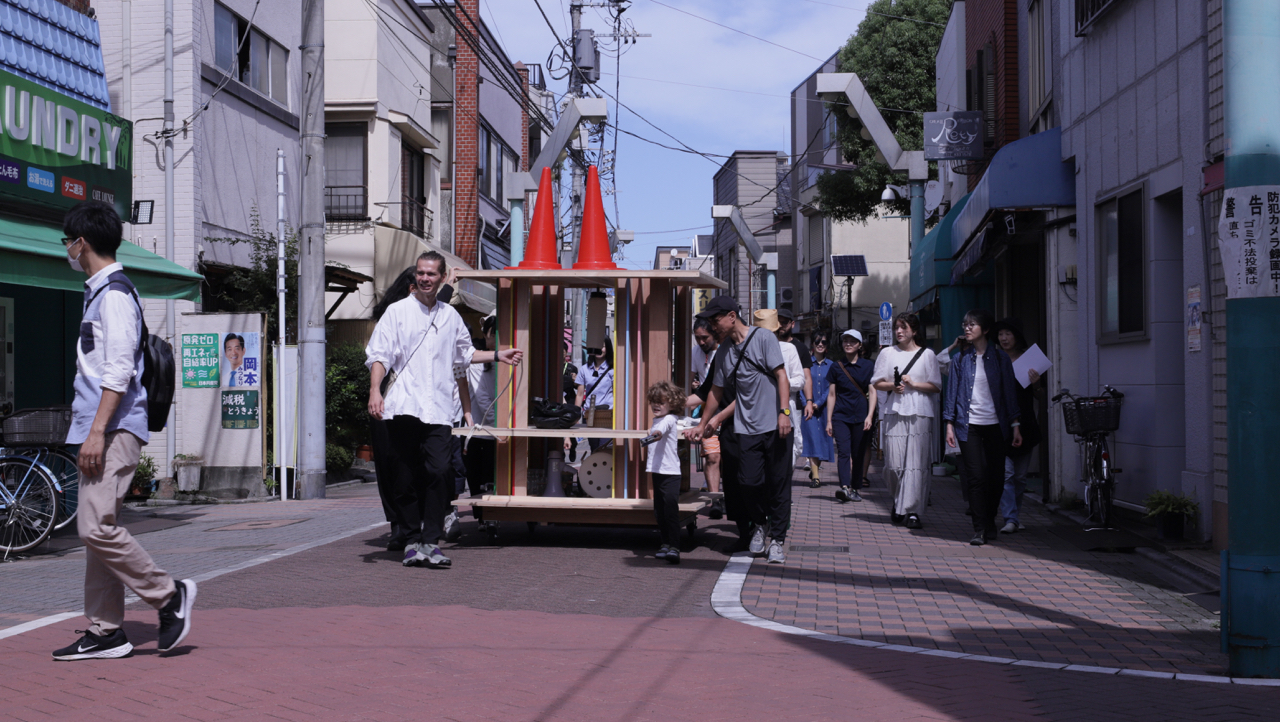
The PARK-PLATZ vehicle starts wandering, from Higashi-Ogu 5-chōme 14–13 to Sunny Park (Higashi-Ogu 4-chōme 31), Tokyo, 24 September 2023, image courtesy of Studio GROSS
As part of this initiative, I was invited by Studio GROSS to design and facilitate an intervention for that day, along with the artist Maurizio Cirillo. I thought that a variation of 1000 A4 washi cosmos squares would be suitable for this occasion. I had implemented a previous version of the work in the exhibition ‘Crystal Clear’, an experimental performance exhibition in Nakacho House, Tokyo, in 2022, where it grew in every corner of the building. [11] In this participatory project, each person is encouraged to assemble a specially designed paper object and place it in the space – in this case, the vehicle. As the title indicates, the project consists of a thousand laser-cut washi papers. The object is a composition of characteristics I have observed that enhance interactivity, such as size and structure, which allows for immediate plasticity with the hands, and repetitive circles, facilitating the easy creation of three-dimensional structures. The objects are cut out from A4 sheets, which are also piled up in the space.

One of the 1000 laser-cut washi paper cutouts, 2022, photo by the author
The project is inspired by Deleuze and Guattari’s idea of the rhizome. [12] In botany, a rhizome (or a rootstalk) is a horizontal, non-hierarchical system of growth, without a central root or trunk. In the view they propose, the rhizome functions as a metaphor for non-hierarchical, multiple and open connections – a system without a centre, beginning or end. Participants in Tokyo were initially asked to collectively weave a plane, onto which they were then expected to weave their subjectivities.
The vehicle started out from Studio GROSS at 11 o’clock in the morning and ended at 6 pm on the same day. It made stops at five parking lots in the area. The 1000 A4 washi cosmos squares would constitute two of the interventions, but ultimately, the interaction with the work was continuous at all stops and during walking. At the first stop at サニーパーク [Sunny Park], I gave an introduction to the work and explained that in the first phase, we would weave a horizontal plane.
However, the plane was never woven horizontally. The approximately forty-five participants began to weave relatively randomly but in a way that stabilised the individual papers in the collective. Some asked me more about the idea behind the project, but most were playing with the paper objects and adding to this chaotic, ephemeral, and at the same time grounded and collectively shaped grid. Once again, the interaction reminded me that coming together and implementing always has unexpected results.

Stop at Sunny Park, Higashi-Ogu 4-chōme 31, Tokyo, 24 September 2023, image courtesy of Studio GROSS
At the next stops and until the end of the action, the collective sculpture continued to evolve. Some papers fell out during the transit, and some of the participants collected them and ran to catch up with the moving vehicle. Some seemed particularly intrigued by the structure and growing of the work and approached me to discuss it. Two children, around five years old, settled inside the vehicle, surrounded by the now paper laces – they remained there for hours, playing, making new objects, drawing on the papers. Each one found their own space, inside and outside.
The last stop was at the コナカ [Konaka] parking lot, which is located on a corner of a large street, almost an avenue. Due to the location, the wind blew both people and papers around. At this stop, Anne Gross and Masamichi Tamura read some excerpts from Burckhardt on strollology and moderated a discussion on the importance of creating public spaces through actions such as this one. The discussion seemed to motivate many of the participants. Tokyo is a constantly changing city that remains fascinating to walk in. At the same time, opportunities for public gatherings, especially after the coronavirus pandemic, are becoming increasingly scarce.
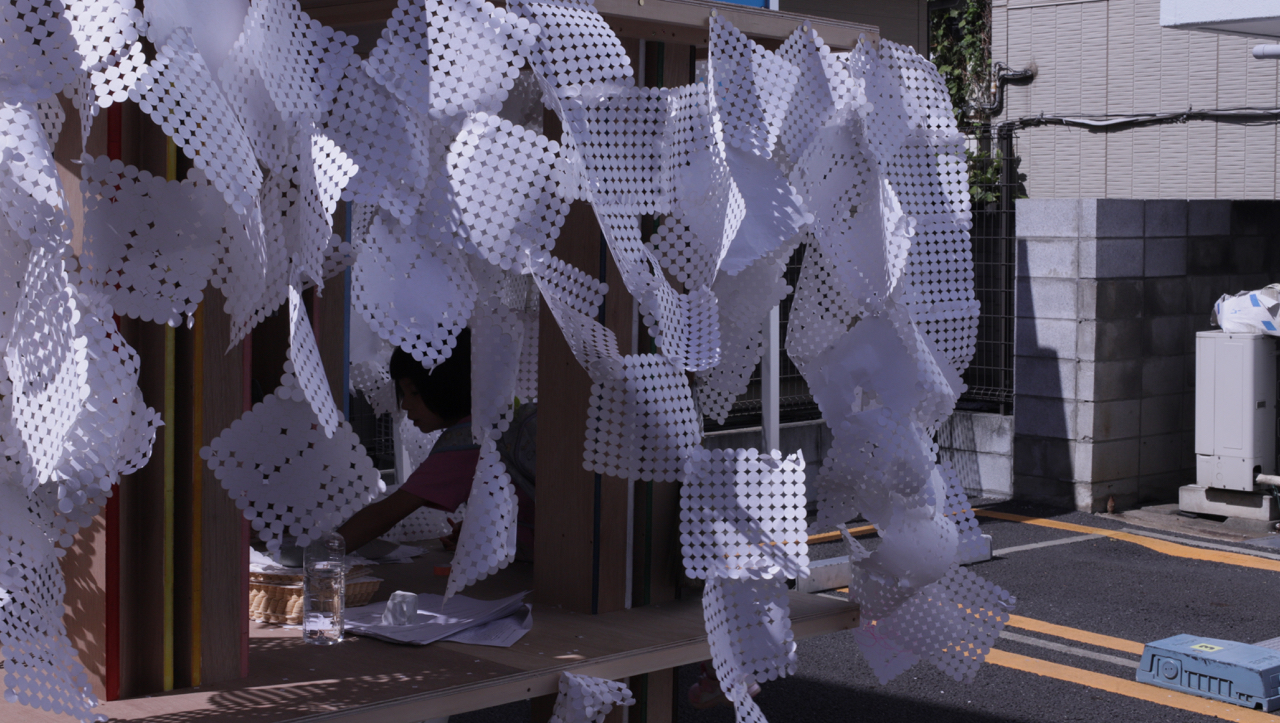
Wind and fortress, photographed during the walk, Tokyo, 24 September 2023, image courtesy of Studio GROSS
Around 6 pm, and when it started to get dark, we returned to Studio GROSS. My own perspective on the project had already changed through the gazes, movements, questions and narratives of the participants. As a facilitator, participant and observer, I was left to the uncertainty, the process, the coexistence. For some, the project was an architectural puzzle or social commentary; for others, a manual activity that accompanied wandering, exploration and discussion. For the two children mentioned above, it was an enviable temporary fortress. In every case, the warm participation in the action showed that there is a need for more public play, curiosity and encounter.
From the moment the 1000 A4 washi cosmos squares were placed in the public space, they began to take shape, rhythm and direction. They became a collective, polyphonic creature. They constituted a framework where material sensitivity encouraged the expression of subjectivity. The exploration of the meaning of subjectivity through washi materiality is something that took a different form in the later work that I describe below, geometría polisentimental.
geometría polisentimental, Havana, November 2024
In August 2024, I submitted a proposal to the TURN Project Open Call. TURN is an artistic programme that promotes interaction and expression through encounters between people with different backgrounds, such as people with or without disabilities, people of different generations, genders, nationalities and living conditions. [13] The open call was addressed to students and graduates of the Tokyo University of the Arts, where I was a doctoral student at the time. The request was for a project within the framework of the Havana Biennale in collaboration with organisations related to people with disabilities in Havana. The project should encourage co-creation through Japanese traditional techniques.
My proposal was titled geometría polisentimental, inspired by the homonym song by Fangoria, [14] which calls us to emotional, intuitive, subjective systems and communications. The original plan was to create sensory maps of Havana together with members of the Cuban Association of People with Intellectual Disabilities (Asociación Cubana de Personas en Situación de Discapacidad Intelectual, hereafter ACPDI). During a three-to-five day workshop, we would make our own papers with papermaking materials that I would bring from Japan, and then, on this paper, we would visualise sensory mappings. With this project, I would present two of my driving interests – Japanese papermaking and sensory ethnography. At the same time, through those interests, I would create a framework for dialogue and exchange of experiences with people living in Havana.
Japanese papermaking, 和紙 [washi], is what originally brought me to Japan. It has many innovative features, such as being made from the inner branches of the mulberry tree, the so-called kozo, unlike Western papermaking, which uses the entire tree. In addition, washi is more fibrous and therefore more durable than Western papers made from pulp. However, there are fewer and fewer washi-making workshops, and fewer and fewer kozo farms. At the same time, since the time that I arrived in Japan until today, my relationship with papermaking has grown physically without verbal language. For this reason, I considered that the activity of papermaking was suitable for the framework of the programme in Havana, where people with different spoken or non-verbal languages would work together.
Another interest of mine, a relatively recent one at the time, is sensory ethnography – that is, the anthropological approach that emphasises experience through the senses, focusing on how we see, hear, touch and feel the world during fieldwork. [15] Through the workshop in Havana, I wanted to create maps with the members of ACPDI that encompass their real experiences. The resulting maps would not show the ‘objective’ map of Havana, but the subjective, ephemeral, instantaneous map(s) of the city.
My proposal was selected together with that of Motoki Watanabe, who proposed studying the intersection of Cuban and Japanese masks and performative practices. The preparation went quite smoothly, and at the end of October, the two of us made the two-day trip from Tokyo to Havana, where we would stay for four weeks. Arriving in Cuba, we found ourselves in the midst of the effects of a four-day national power outage. Nevertheless, the curator Maria Alejandra Sanchez Bernal and the guest institutions welcomed us with warmth and a willingness to guide us through everything. Ultimately, both my personal experience and the workshop were revealing, because for the first time I was in a socio-economic context structured differently from the capitalist environments I was accustomed to.
In the second week, I started going to the ACPDI so that its members could become familiar with my presence and I could learn more about their activities. The Association is mainly made up of adolescents and young adults on the autism spectrum, and people with intellectual disabilities and their mothers, mainly single-parent families. It was the first time that I would facilitate a workshop for people with disabilities, and I was reserved and open to learn from the community. Yet, throughout most of my life, I have coexisted with disabilities – two of my grandparents were deaf, and my mother is an educator of people with disabilities.
The Association is one of the most beautiful places I have ever been in my life, a place of joy, love, understanding, humour and communication. For a week, we played, painted, coexisted, danced, sang and learnt how to communicate with each other. I did not speak Spanish, and yet the members and their mothers included me, taught me new things, and offered me new universes of understanding of the world. The tender moments of these interactions and the lessons I learnt are immeasurable.
The third week, the one of the workshops, arrived. On the first day, we made our own papers, on which, in the second activity, we would draw the maps. About fifteen ACPDI members and some of their guardians participated. The process evolved very dynamically. For about three hours, we did warm-up activities; then I explained the differences between Japanese and Western paper, and we then moved on to papermaking. The participation was extremely warm and collaborative. Everyone joyfully awaited the development of the workshop during that week.

Papermaking at the Cuban Association of People with Intellectual Disabilities (ACPDI), Havana, 4 November 2024, photo courtesy of the TURN Project
The next day, Hurricane Rafael came to Havana, followed by a power and water outage. The sensory mapping workshops could not, unfortunately, take place, as everyone’s safety was the priority. With a small group and before everything was closed, we made indicative maps, recording parts of our daily lives in Havana. In addition, we experimented with making paper, including leaves and objects that were collected while wandering around the ACPDI garden.
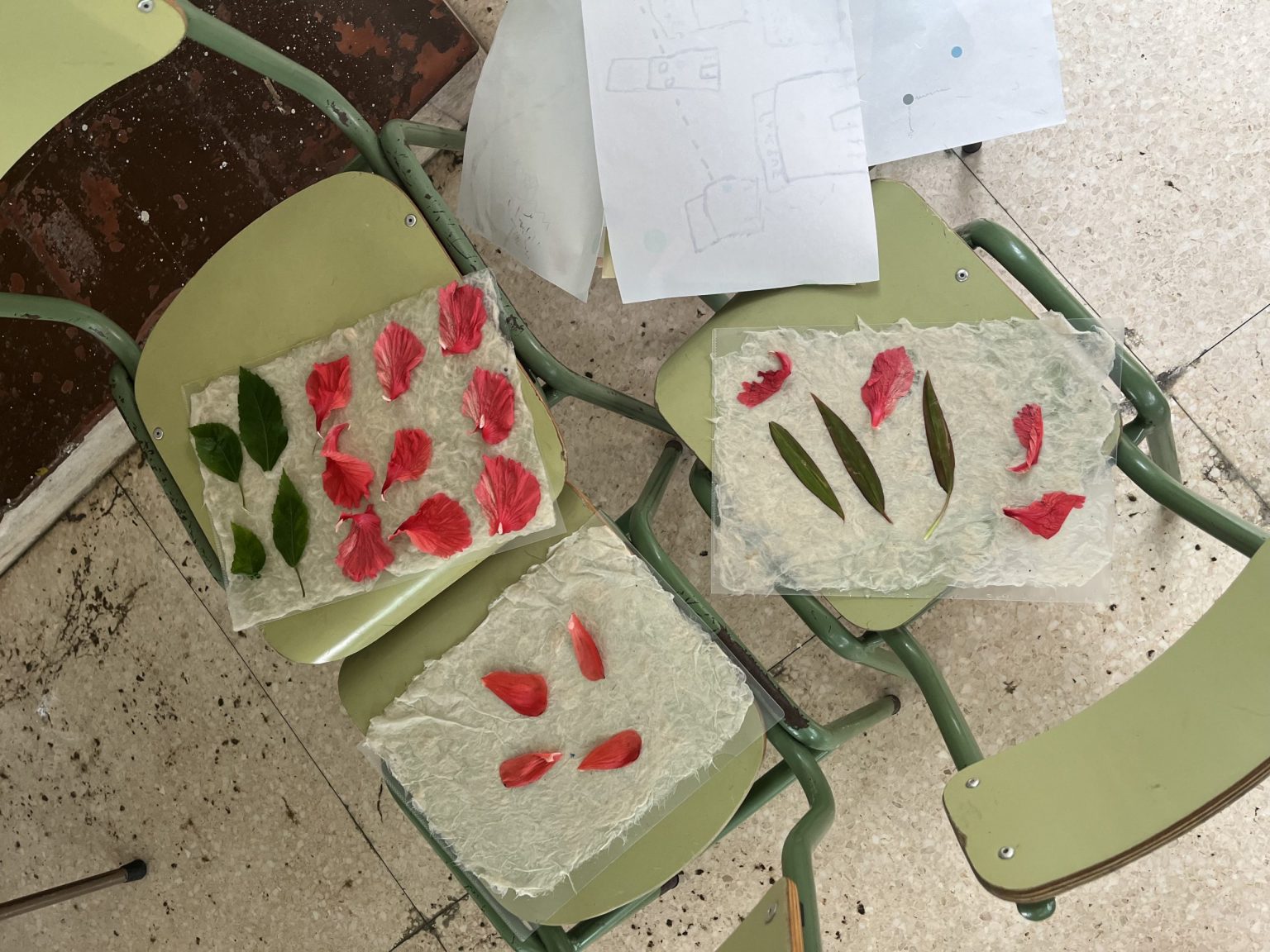
Experimental papermaking at the Cuban Association of People with Intellectual Disabilities (ACPDI), Havana, 5 November 2024, photo by the author
When the hurricane had passed and shortly before the Biennale was set up, we created a ‘script’ with the ACPDI coordinators (see Table 1). It was a methodology for creating the sensory maps, when it would be possible to continue the workshop smoothly with the same people (without my physical presence, since my stay in Havana was soon ending). Due to the hurricane, we would not be presenting the group’s work at the Biennale (as it had not been produced), but it seemed possible to create a participatory installation, which would be implemented at the opening, not only by members of the group, but also by any other members of the audience.
SENSORY MAP INSTRUCTIONS (composed by the author)
how to make your sensory map
(it can last very short or very long, from five minutes to five hours, the time depends on you)
PART I: individual map/fragment
● Pick up the paper you have made.
If you haven’t made any paper, take a paper from the separate pile, or any surface.
● Consider one day in your life:
Where do you wake up?
What is the first thing you do?
Who are the people you interact with?
Which path(s) do you usually walk?
What is a smell you enjoy?
a taste?
a view?
Feel free to think of other questions related to your life.
You can use any medium and material to answer those questions. Such as drawing, performing, taking photos, singing, with markers, stickers, tapes, your voice, body movements, papers, glues, anything.
PART II: collective map
● If you are by yourself, consider the relationship of your map with the room: is there something on your map that repeats in the physical space around you? Like light, smell, a walking path?
If you are with other people, find your common locations or feelings.
PART III (optional): creatures
● After everyone finished their maps, start making the creatures that live in them.
What kind of plants, animals, buildings, imaginary characters, or any other objects live in your and other people’s maps?
You can use the colourful papers to draw, cut, shape those creatures.
Place your map in the space. Share it with others.
Finally, at the opening, we presented the papers that the ACPDI members made before the hurricane; the indicative sensory maps that we constructed with the smaller group shortly before the confinement; the ‘script’ that we wrote with the coordinators; and the interactive installation that was implemented in situ by the attendees.
The experience of geometría polisentimental in Havana confirmed to me that art is a common language between people containing diverse multiplicities. The hurricane was a challenge. The interruption of the workshop and its subsequent revision revealed to me the importance of the adaptability of the method in the field of socially oriented art. Departing from Havana, I was now accompanied by an open, applicable, negotiable methodology that responds to the conditions and the city at hand. The action we carried out in Havana can take different forms: not only on paper, but also in the body, in voice, in movement, in memory. Walking and experiencing the city become part of a multifaceted system of knowledge production, both embodied and subjective.
Conclusion
Both the Tokyo and Havana workshops share elements regarding the approach of collective creation, the materiality of paper and the walking experience of the city. In 1000 A4 washi cosmos squares, participants were invited to compose a sculptural system together, while in geometría polisentimental, participants collaborated to create sensory maps of Havana from scratch. In both cases, the participants are key contributors to the art process.
Both workshops took place in public spaces, enhancing the interaction of the audience with the urban environment. In the first, the intervention takes place and pours out into various public spaces in Tokyo; while in the second, the creation of the sensory maps incorporates elements of the city of Havana. Both projects highlight public space as a field of encounter and co-creation and offer an intense sensory experience to the participants. Ultimately, both workshops brought together different cultural and inclusive practices – beyond shared languages and identities.
Despite the similarities, the two projects have different ‘goals’. In 1000 A4 washi cosmos squares, the emphasis was on the instinctive shaping of the project in interaction with the urban landscape. In geometría polisentimental, the emphasis was on sensory mapping, focusing on the personal experiences of the participants. The two projects also differed in the intensity and direction of participation. In the one-day 1000 A4 washi cosmos squares, the dynamics were explosive due to the short duration. In the multi-day geometría polisentimental, precisely because of the prolonged interaction and collaboration, the project was slower and evolved along with the intellectual and emotional connection with the place and its people.
The exploration of artistic practices in public space, as carried out through these two wandering sensory workshops in Tokyo and Havana, demonstrates the importance of participation and intergenerational interaction in the experience of public spaces. Through the encounter of cultures and by utilising the itinerant experience, opportunities were created for collective expression, social empowerment and emotional exploration. Even within the public spheres, art practices can attend to intimacy, subjectivity and collectivity, in ways that expand perceptions of inner and outer worlds.
Acknowledgments: I am grateful to the participants of 1000 A4 washi cosmos squares and their rhizomatic expansions, as well as Studio GROSS and Goethe Institut Tokyo, for making me part of ‘Urban Walks’. I am deeply thankful to the members of the Cuban Association of People with Intellectual Disabilities and the Havana Biennale for embodying geometrìa polisentimental. This article began as a presentation at the 11th International Scientific Conference organised by the Institute of Humanities and Social Sciences in Heraklion, Crete, in 2025, and developed through conversations with Katerina Kyriakou. Thank you also to aliwen, hanna hirakawa and Motoki Watanabe, for their support throughout the projects.
[1] See, for example, Styliani Bolonaki, ‘Public Art: A Review. Social and Political Practices’, European Journal of Creative Practices in Cities and Landscapes, vol 6, no 2, 2024, pp 39–54 (downloadable PDF), accessed 15 May 2026
[2] See Suzanne Lacy, ed, Mapping the Terrain: New Genre Public Art, Bay Press, Seattle, Washington, 1995
[3] See Claire Bishop, Artificial Hells: Participatory Art and the Politics of Spectatorship, Verso Books, London and New York, 2012
[4] See Nicolas Bourriaud, Relational Aesthetics, Les Presses du Réel, Dijon, 1998
[5] See Sumiko Kumakura and The Art Project Research Group, An Overview of Art Projects in Japan: A Society That Co-Creates with Art, translated by the Art Translators Collective, Arts Council Tokyo, 2015
[6] See Carolyn Ellis, Tony E Adams and Arthur P Bochner, ‘Autoethnography: An Overview’, Forum Qualitative Sozialforschung / Forum: Qualitative Social Research, vol 12, no 1, 2011, p 1 (downloadable PDF), accessed 15 May 2026
[7] See Gayle Letherby, ‘Feminist Auto/Biography’, in The SAGE Handbook of Feminist Theory, Mary Evans et al, eds, Sage Publications, 2014
[8] See Goethe-Institut Korea, ‘Spaziergänge in Der Stadt – URBAN WALKS’, 2024, accessed 15 May 2026
[9] See Anne Gross, Sebastian Gross, Masamichi Tamura and Yoshiharu Tsukamoto, ‘Strollological Intervention into Everyday Urban Environment of Shitamachi Neighborhood, Tokyo’, AIJ Journal of Technology and Design, vol 31, no 77, 2025, pp 556–561, specifically section 1.1 (downloadable PDF), accessed 15 May 2026
[11] See https://aaa-senju.com/2022/p/14933, accessed 15 May 2026
[12] See Gilles Deleuze and Félix Guattari, A Thousand Plateaus: Capitalism and Schizophrenia, University of Minnesota Press, Minneapolis, 1987
[13] See ‘TURN’, accessed 15 May 2025
[14] See Fangoria, Geometría Polisentimental, 2016, on YouTube, accessed 15 May 2025
[15] See Phillip Vannini, ed, The Routledge International Handbook of Sensory Ethnography, Routledge, 2023
Chloe Pare-Anastasiadou is a visual artist and researcher, and currently an Assistant Professor at the School of Cultural and Creative Studies at Aoyama Gakuin University, Tokyo, Japan.